A quick peek at the much awaited Ipad launching.
Showing posts with label periodismo. Show all posts
Showing posts with label periodismo. Show all posts
Thursday, January 28, 2010

Wednesday, January 27, 2010
Monday, January 25, 2010
Where is my paid content?
Newspapers are crying, "WHO HAS BEEN TASTING MY SOUP?". Have they been too willing to give away their content?
Sunday, January 24, 2010
Friday, January 22, 2010
Wednesday, January 20, 2010
Content creation opportunities
You might want to check Mike Shatzkin's presentation at the BEA, or his Publishing Points series of lunchtime talks to get a feel of what's coming from a book publishers' perspective.
My feeling is that what book publishers are experiencing today with technology, newspaper publishers may very well experience in the near future. On Kindles and e-readers, book format reproduction has been a child's play.
He highlights the obvious dominance of specialized-vertical over general-horizontal publishing in the new search publication environment.
I strongly feel that he falls short in his appreciation of the consequences of the laser focused search pushed publishing. I don't feel there's room for the publisher to guide the book author any longer.
Why would an author approach a publisher, when a healthy search engine optimization of his work should suffice?
As Mike mentions, the usual publisher's marketing wares, —book clubs, newspaper reviews, magazine and newspaper ads, and others—, are too expensive or rapidly disappearing.
Nevertheless, his presentations touch on what I think are a few crucial and far reaching points, which we need to appreciate on the newspaper publishers side of the fence:
- Building or maintaining communities is at the core of it all. Well-known places will always occupy a space in our minds. People will always visit the New York Times, as well as, their local newspaper's print, online, or phone presence, to look for what's happened in their community. As a consequence, newspaper brands are relevant, and must be nourished —with likable presences in any new format, like: Facebook, YouTube, MySpace, Twitter and others.
Mike's take:We are all in the conteNt business, and we are going to have to move into the conteXt business. The ownership in the future of eyeballs will be more important than the ownership of IP, because value moves to scarcity. This is immutable, you cannot change this. Content creation and distribution are no longer scarce. Anybody can do them. Distribution is not an issue. I can type something on my computer today, I can flip it to my website, it is distributed. Any body in the world, on the web, can get it. The problem is, will they know about it? That’s the problem. Marketing is the problem. Distribution is no longer the problem. And you’re going to do your marketing niche by niche, and nugget by nugget, and it does require scale. If you don’t have enough content, or clout in a community, you won’t be heard. If you don’t pay enough attention or put enough labor into a community, you won’t be able to command the attention of that community.
- Content creation, on the other hand, opens new doors of opportunity. Publishers must take advantage of the fact that it's been their business to know all the intricacies of how to better connect the creator to his audience. They should offer this service to those countless companies needing to show a pretty face to the world —which is better known as publishing.
Mike's take:Publishers also recognize creative possibilities and ideas that aren’t fully developed. As a matter of fact, publishers usually buy projects based on ideas that are not fully developed, and participate in the development of ideas. That is a very important skillset. That doesn’t go away. And the publisher is coordinating the whole range of disparate activities that are necessary to connect the creator to an audience. You know what that is, it’s putting the art in the book, it’s deciding what typeface, it’s deciding what price, it’s deciding how to market, but sometimes it’s finding a co-author for the book, or sometimes it’s finding an illustrator. So sometimes you’re actually connecting the creators with each other, as well as providing the detailed management that the creator needs. Actually, I believe, is the most important skill set of publishers is that they manage a massive amount of detail. Which the authors would very rapidly table themselves up in knots if they managed for themselves. That is the scale opportunity that publishers present, and that is not going to change. It’s actually going to be even more necessary in the web.
So, it's time you guys get out there to offer your creation and presentation wares...
Good luck.
Saturday, January 9, 2010
Are e-readers the holy grail?
As I try to unclutter my garage, —a consequence of procrastinating the decision of what to do with this and that, typewriters definitely have to go this time around—, I'll try to see if e-readers really have the magic for news delivery as its been touted long before the current San Francisco Las Vegas CES show.
CNETting the CES comments on e-readers and the like, the Intel LG smartphone and Nvidia Tegra II tablet although pricey, knock me off my feet. You must watch the videos to get a feel of their navigation, images won't do.
Here's the thing. I've always thought and I've tried to make the point that we humans —our readers— are a lot more complex than what meets the eye. If you don't believe me, check Levin's apologies here, or how he lost trillions believing that online news was going to be the hole in the donuts, going forward with the Time Warner - AOL merger.
Levin concurs that the consumer "experience" is driving online traffic.
Aha! I think it'll be safer to keep the stuff I don't understand while my wife is away on vacation, —better safe than sorry, don't you agree?
Bottom line: the devil is in the details. All the dah-dah and doo-doo has to be weighed against this fact. As a good example, videos (even laptop screens) hinder the tranquil zen-like environment of news-paper reading, which is so helpful to its advertising.
I'm sure designers will agree that typeface, font size, leadings —which, seem to be minute issues— are precisely what makes reading effortless and transparent. But, by moving news into an immense and totally different media, like the Internet, people tend to forget these basic axioms.
E-ink and touch-screen (operating systems) adoption in e-readers are enormous strides towards making these machines less objectionable to magazine and newspaper reading —dramatically improving reading eye stress and navigation.
As a matter of fact, the tablet should reign as the new laptop hardware standard. It's easy to foresee that touch-screens will also serve as keyboards when needed, making manufacturers drop keyboards altogether.
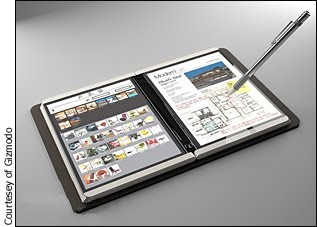
Or, double up, as in the case of Microsoft's Courier project.
When that time comes, pricing will not be an issue. I'm curious of why manufacturers are not following this path, is it the Newton's legacy of fear?
How far away in the future is the $500 all encompassing computer-tablet?
How is it that some of us keep garages so nicely organized?
Love to hear your thoughts.
CNETting the CES comments on e-readers and the like, the Intel LG smartphone and Nvidia Tegra II tablet although pricey, knock me off my feet. You must watch the videos to get a feel of their navigation, images won't do.
Here's the thing. I've always thought and I've tried to make the point that we humans —our readers— are a lot more complex than what meets the eye. If you don't believe me, check Levin's apologies here, or how he lost trillions believing that online news was going to be the hole in the donuts, going forward with the Time Warner - AOL merger.
Levin concurs that the consumer "experience" is driving online traffic.
Aha! I think it'll be safer to keep the stuff I don't understand while my wife is away on vacation, —better safe than sorry, don't you agree?
Bottom line: the devil is in the details. All the dah-dah and doo-doo has to be weighed against this fact. As a good example, videos (even laptop screens) hinder the tranquil zen-like environment of news-paper reading, which is so helpful to its advertising.
I'm sure designers will agree that typeface, font size, leadings —which, seem to be minute issues— are precisely what makes reading effortless and transparent. But, by moving news into an immense and totally different media, like the Internet, people tend to forget these basic axioms.
E-ink and touch-screen (operating systems) adoption in e-readers are enormous strides towards making these machines less objectionable to magazine and newspaper reading —dramatically improving reading eye stress and navigation.
As a matter of fact, the tablet should reign as the new laptop hardware standard. It's easy to foresee that touch-screens will also serve as keyboards when needed, making manufacturers drop keyboards altogether.

Or, double up, as in the case of Microsoft's Courier project.
When that time comes, pricing will not be an issue. I'm curious of why manufacturers are not following this path, is it the Newton's legacy of fear?
How far away in the future is the $500 all encompassing computer-tablet?
How is it that some of us keep garages so nicely organized?
Love to hear your thoughts.
Thursday, January 7, 2010
Spot.US: a silver bullet?
David Cohn,
a candid interview
I wasn't expecting to find such an interesting news model —but David Cohn's Spot.Us is something else.
Spot.Us is a nonprofit project of the Center for Media Change funded by various groups like the Knight Foundation.
When asked, David Cohn sees his organization's mission as that of a provider of local investigative reporting, funded by the community.
The process is initiated with news "tips" that the community feels are stories worth covering. Reporters propose news "pitches" based on these tips, while editors from Spot.Us provide an estimate of the cost, and screen both pitches and reporters. Finally, the community or news organizations finance through their donations each approved pitch.
And it doesn't end there, if a news organization finances 50% of the cost, it gets the exclusive. If not, it will get published at no cost at any organization willing to publish it — blogs, New York Times... Of course, we're talking of a 100% financed story. If not, it gets scrapped —well, not really... the reporter involved could also donate part of his time too.
Finally, this is an Open Source project. I read that there's already a site in Japan using the same piece of software.
Wednesday, January 6, 2010
Why News-in-papers?
Why should publishers use paper?
If you really want to get a deeper look into this problem, I suggest you read (the 75 pages of) Hamlet's Blackberry: Why Paper is Eternal, by William Powers, or you can check the excerpts in italics down below.

Courtesy of Polish Posters
This question brings me back to Heidegger's assertion, the great philosopher of the 20th century, that we are truly very complex creatures. So complex, according to Dreyfus, that we may never be copied by computers.
The following cloud of concepts gives us a good overall feeling of how media outlets differ:
| Print | Online | TV |
| in the flow | annoying | captivating |
| limited | powerful | glamorous |
| settled down | search and destroy | entrancing |
| immerse | fleeting | fleeting |
| thinking & planning | quick read | attractive |
| closed and finite | immense | transient |
| select | inscrutable | |
| motionless | unstable | |
| immutable | unwieldy | |
| satisfying | overwhelming | |
| easier editing | difficult editing | no editing |
| light reflecting | light emitting | light emitting |
| easy on the eyes | toll on eyes and brain | |
| easy navigation | tolling navigation | minimum navigation |
Like the hinged door, paper magazines have thrived deep into the electronic age because the way they convey information remains, for some purposes, more useful and satisfying, in ways that can be hard to describe except anecdotally.
Paper not only conveys tranquility by being immutable, but there are times, when we need to think with our hands. I still prefer to get my bank statements in paper. I also jot down telephone numbers and ideas, as well as, do some note taking and planning on paper.
And although digital servers have made paper storage obsolete, or libraries cannot compete with digital database sorting and others, paper is still an excellent communication device. I print my digital travel itineraries, kids’ homework and copies of important presentations. And, I would only send condolences in a hand written note —no e-mail here.
Which brings us to recognize maybe the most notable property of paper: it adds a distinct "value" to its message.
Paper has intrinsic qualities that: 1)make it easy and enjoyable to work with, 2)help us make sense of information and 3)are conducive to certain kinds of reading and thinking, —properties that new media, for all their wonders, have not yet been able to match.

reading our favorite section of the newspaper.
It's amazing to realize that magazines and newspapers have clear advantages over online and TV advertising, precisely, because of its lack of hoopla. The magazine and newspaper experience is a quite one, —readers view their ads when they please and within a peaceful Zen attitude. In contrast, readers tend to avoid ads in Online's speed reading and TV's entrancement environments. In the former, readers are too focused in their urgent search; and in the latter, they react annoyed by skipping channels, —TV ads interrupt their entrancement.
And this is why news-in-paper alongside ads-in-paper persist in making a golden couple, —it's good company. By the way, the market cap increase for newspapers for 2009 was spectacular.
Wish you well.
My Blackberry abridged edition:
Sellen and Harper found that paper has four affordances that specifically assist reading:
(1) Tangibility. This refers to the way that we navigate a paper document or book using our eyes and hands together. “When a document is on paper, we can see how long it is, we can flick through the pages . . . we can bend over a corner while searching for a section elsewhere. In other words, paper helps us work our way through documents.”
(2) Spatial Flexibility. When working with multiple paper texts, they can be spread out around a large area or reduced to fit a smaller space, depending on our needs.
(3) Tailorability. With paper it’s easy to underline, scribble in the margins and otherwise annotate a text we are reading.
(4) Manipulability. Because paper can be moved around, one can shuffle effectively among different paper sources, for example putting one page aside in order to concentrate on another.
The first of these, tangibility, isn’t available at all on a two-dimensional screen. The others are more difficult to achieve with computers and other electronic media, as anyone who has “written” in the margins of a digital document can attest. As the authors put it, “It is as if people need to use their hands and eyes to fully grasp the meaning of the text in question. People really do understand what a document conveys by physically getting to grips with it.
“[T]he physical feel of the paper meant that little attention (and especially visual attention) had to be given over to the task of page turning. Much of the information needed to navigate was both implicit and tactile. Similarly, physical cues such as thickness of the document provided important tacit information about where in the document the reader was. All of this . . . meant that readers were not distracted from the main visual task.”
In contrast, one of their subjects had this to say about online reading: “I was getting very annoyed and clicking on those things and shouting at it . . . . I just found that it took ages and ages. I was losing interest – it was distracting me from the point.”
Thirty-six consumers were interviewed, half of them frequent magazine readers. The other half were people who watched at least two hours of commercial television a day and also read at least one magazine a month. The study found that the way consumers react to ads in hard-copy magazines is in fact very different from how they respond to commercials on television.
The distinction came down to a matter of control. Because viewers cannot control when TV commercials are shown or how long they will last, they tend to feel trapped by the ads, which those in the study spoke of as disruptive, distracting and annoying.
Meanwhile, the subjects had largely positive views of ads in magazines, and the main reason seemed to be the sense of control that paper inherently affords: The reader turns the pages at will, deciding what to look at and for how long. One subject said: “A magazine ad is like a glass of wine because I have the time to sniff it and appreciate it . . . It’s there, I can take it or leave it . . . . Because I have control, I can take the time to make particular decisions [about] which ads I will savor and absorb.”
In the last decade, digital reading has become a part of everyday life, yet it hasn’t replaced reading on paper. McDonald says that at the moment screens are not used predominantly for flow-style reading – settling in and losing one’s bearings – but for a kind of high-intensity foraging. “When one is reading on the screen, it’s sort of like speed reading, information-retrieval mode. ‘I’m looking for something. Now I’m looking for something else.’ It’s very purposeful, it’s very utilitarian. . . . There’s something about it being on the screen that signals to people to hurry. It’s pushing the page-down button, just having your finger on the clicker and scrolling. It’s a higher speed, more nervous kind of thing.” Screen-based reading, he says, is “very much about ‘search and destroy.’”
The paper news should provide long-form, in-depth coverage, while the Internet should be interactive, immediate, provide an open dialog with the audience and throw in all those nifty doo-dads and videos people love to play with.” This distinction is not so much generational as operational.
The digital medium serves up content differently from paper, and we go to it for different kinds of reading experiences – “search and destroy” versus “settle down.”
It has little to do with age and everything to do with the human mind, which does not evolve so quickly that those born after 1980 read and think in a fundamentally different way from everyone who came before them. In effect, the content that works best on the Web, for readers of all ages, has migrated there, while the “long-form, in-depth” stuff clings tenaciously to paper (even when it’s on the Web, people are less likely to read it there).
Thus the public exodus from newspapers is not a rejection of paper, but an objection to using it for hard news and other utilitarian, quick-read content (including, not incidentally, classified ads) that gains little or nothing from arriving in that format. It’s because this content has always been the core mission of newspapers – they’re called newspapers, not “essaypapers” – that the industry finds itself in the tough spot it’s in. The two sides of its culture have been pulled apart, and the side that drives the franchise wound up in a not-so-profitable medium.
(1) Tangibility. This refers to the way that we navigate a paper document or book using our eyes and hands together. “When a document is on paper, we can see how long it is, we can flick through the pages . . . we can bend over a corner while searching for a section elsewhere. In other words, paper helps us work our way through documents.”
(2) Spatial Flexibility. When working with multiple paper texts, they can be spread out around a large area or reduced to fit a smaller space, depending on our needs.
(3) Tailorability. With paper it’s easy to underline, scribble in the margins and otherwise annotate a text we are reading.
(4) Manipulability. Because paper can be moved around, one can shuffle effectively among different paper sources, for example putting one page aside in order to concentrate on another.
The first of these, tangibility, isn’t available at all on a two-dimensional screen. The others are more difficult to achieve with computers and other electronic media, as anyone who has “written” in the margins of a digital document can attest. As the authors put it, “It is as if people need to use their hands and eyes to fully grasp the meaning of the text in question. People really do understand what a document conveys by physically getting to grips with it.
“[T]he physical feel of the paper meant that little attention (and especially visual attention) had to be given over to the task of page turning. Much of the information needed to navigate was both implicit and tactile. Similarly, physical cues such as thickness of the document provided important tacit information about where in the document the reader was. All of this . . . meant that readers were not distracted from the main visual task.”
In contrast, one of their subjects had this to say about online reading: “I was getting very annoyed and clicking on those things and shouting at it . . . . I just found that it took ages and ages. I was losing interest – it was distracting me from the point.”
Thirty-six consumers were interviewed, half of them frequent magazine readers. The other half were people who watched at least two hours of commercial television a day and also read at least one magazine a month. The study found that the way consumers react to ads in hard-copy magazines is in fact very different from how they respond to commercials on television.
The distinction came down to a matter of control. Because viewers cannot control when TV commercials are shown or how long they will last, they tend to feel trapped by the ads, which those in the study spoke of as disruptive, distracting and annoying.
Meanwhile, the subjects had largely positive views of ads in magazines, and the main reason seemed to be the sense of control that paper inherently affords: The reader turns the pages at will, deciding what to look at and for how long. One subject said: “A magazine ad is like a glass of wine because I have the time to sniff it and appreciate it . . . It’s there, I can take it or leave it . . . . Because I have control, I can take the time to make particular decisions [about] which ads I will savor and absorb.”
In the last decade, digital reading has become a part of everyday life, yet it hasn’t replaced reading on paper. McDonald says that at the moment screens are not used predominantly for flow-style reading – settling in and losing one’s bearings – but for a kind of high-intensity foraging. “When one is reading on the screen, it’s sort of like speed reading, information-retrieval mode. ‘I’m looking for something. Now I’m looking for something else.’ It’s very purposeful, it’s very utilitarian. . . . There’s something about it being on the screen that signals to people to hurry. It’s pushing the page-down button, just having your finger on the clicker and scrolling. It’s a higher speed, more nervous kind of thing.” Screen-based reading, he says, is “very much about ‘search and destroy.’”
The paper news should provide long-form, in-depth coverage, while the Internet should be interactive, immediate, provide an open dialog with the audience and throw in all those nifty doo-dads and videos people love to play with.” This distinction is not so much generational as operational.
The digital medium serves up content differently from paper, and we go to it for different kinds of reading experiences – “search and destroy” versus “settle down.”
It has little to do with age and everything to do with the human mind, which does not evolve so quickly that those born after 1980 read and think in a fundamentally different way from everyone who came before them. In effect, the content that works best on the Web, for readers of all ages, has migrated there, while the “long-form, in-depth” stuff clings tenaciously to paper (even when it’s on the Web, people are less likely to read it there).
Thus the public exodus from newspapers is not a rejection of paper, but an objection to using it for hard news and other utilitarian, quick-read content (including, not incidentally, classified ads) that gains little or nothing from arriving in that format. It’s because this content has always been the core mission of newspapers – they’re called newspapers, not “essaypapers” – that the industry finds itself in the tough spot it’s in. The two sides of its culture have been pulled apart, and the side that drives the franchise wound up in a not-so-profitable medium.
Monday, January 4, 2010
The new News habitat
Before you start reading, you might want to check out these two excellent posts: from Dan Conover here, and from Clay Shirky here.
I'm watching History Channel's "Monster Dinosaurs". A change in habitat is bad for the prevailing or perfectly adapted animals; extinctions are akin to throwing the dice in evolution, it may or may not give forth better species in the new environment.

The Internet's world wide web
The Internet extends its reach quite a bit, to the www, or worldwide, to the far reaches of the web's network. As a consequence, optimal content should have universal appeal (i.e. Google search, Facebook, Wikipedia).
Publication is immediate and storage —or hosting— costs are close to nil. Breaking news and large archives can take good advantage of the immediacy and database features of sorting, retrieval and linking (i.e. Wikipedia, Google books, Facebook).
Articles, fields within a database, may include text, sound, images and videos. Since more senses are involved, videos should be the preferred communication media (i.e. YouTube).

It's a two-way street, communication can go both ways. The more content from users, the better —it's cheaper. (i.e. Facebook, Wikipedia, MySpace).
Let's try to propose a publication model that takes advantage of these features.
But before we go on, we have to grasp a major Internet limitation —it's computer based. To put it bluntly, it's like pinching a mirror, not much satisfaction in the smell and touch sensory areas; and worse, reading stresses our eyes, quite a bit more than print on paper.

A good example is worth a thousand words...
I found content that works a near perfect example. It develops web page content from thin slices of news: Bridal's Guide, Your Garden, Body & More, Home Style, Car Guide... It extends its reach to readers from a variety of publications through syndicating their service. It's not perfect... it lacks user content derived advantages, and no feed into print.
Beetles are incredible... Far more interesting than dinosaurs.
Love to hear from you.
Sunday, January 3, 2010
Adapting to the new tools of the trade
I've already flatly stated that it's disheartening to see how traditional news outlets still fail to comprehend current technology.
The fact that online editions leave very little money on the table has been a major source of confusion for publishers, hindering online, as well as, in my opinion, print growth.
While I watch an old favorite "Dr. Who's: The End of Times", let's review some of the weaknesses that I feel require an urgent change of course:
It's alarming to see the great number of publications that hold back breaking news from their online edition to protect their print counterpart.
Isn't it obvious that the market is going to exploit this blatant weakness? Why not rethink the online edition as a service to the community with associated benefits. It has the potential side effect to draw readers into both editions, online and print. Greater online traffic not only means greater online ad revenue, but, also should attract subscribers to the associated print editions —if and only if, the contents of these editions are quality topic reader centered articles, with follow-up calls feeding into each other.
This immediately brings us to the major issue of repeatability.
It's quite obvious that these editions must carry different, although, often complementary content. They can deepen their online articles with opinion in the print edition, and broaden their print articles into the inexpensive online edition —with related archive database background.
Content from Wire, TV, radio, and online, needs to be chopped away; carrying brief, or excluding completely, repeat articles in the print edition, to strike an appropriate balance between accomplished news and non-repetitiveness.
And, yes, yes, of course! I'm watching Henry Evans being interviewed by Bloomberg, where he stresses the importance of quality journalism, or in a few more words: the value of honest, unbiased and brave investigative reporting, —which unfortunately we don't see as often as we should.
If you stop to think about it, a bias knocks out the "other" readers from the get go —not a very smart move, if you want good circulation numbers. Honesty, on the other hand, builds the best brand possible for any publication by attracting an extremely loyal following. Further, brave and heroic feats are not only rare, but, admirable, which we also know to attract reader attention by the plain etymology of the word. Did I mention that they're also the right thing to do?
Technology has significantly altered the branding of a publication.
In a technologically dialogue rich world it's very rude not to allow the other person to comment. Further, a publication's persona becomes transparent. Dishonest behavior is spotted from a distance.
If it's not interesting, it's not worth reading...
Journalists must also use and take advantage of the new tools at their disposal to quickly grasp an article's impact, to enable them to quickly morph their publishing topics closer to readers' interests. Again, if you don't, they will.
I'm sure there's a lot more. I'd love to hear from you.
The fact that online editions leave very little money on the table has been a major source of confusion for publishers, hindering online, as well as, in my opinion, print growth.
While I watch an old favorite "Dr. Who's: The End of Times", let's review some of the weaknesses that I feel require an urgent change of course:
It's alarming to see the great number of publications that hold back breaking news from their online edition to protect their print counterpart.
Isn't it obvious that the market is going to exploit this blatant weakness? Why not rethink the online edition as a service to the community with associated benefits. It has the potential side effect to draw readers into both editions, online and print. Greater online traffic not only means greater online ad revenue, but, also should attract subscribers to the associated print editions —if and only if, the contents of these editions are quality topic reader centered articles, with follow-up calls feeding into each other.
This immediately brings us to the major issue of repeatability.
It's quite obvious that these editions must carry different, although, often complementary content. They can deepen their online articles with opinion in the print edition, and broaden their print articles into the inexpensive online edition —with related archive database background.
Content from Wire, TV, radio, and online, needs to be chopped away; carrying brief, or excluding completely, repeat articles in the print edition, to strike an appropriate balance between accomplished news and non-repetitiveness.
And, yes, yes, of course! I'm watching Henry Evans being interviewed by Bloomberg, where he stresses the importance of quality journalism, or in a few more words: the value of honest, unbiased and brave investigative reporting, —which unfortunately we don't see as often as we should.
If you stop to think about it, a bias knocks out the "other" readers from the get go —not a very smart move, if you want good circulation numbers. Honesty, on the other hand, builds the best brand possible for any publication by attracting an extremely loyal following. Further, brave and heroic feats are not only rare, but, admirable, which we also know to attract reader attention by the plain etymology of the word. Did I mention that they're also the right thing to do?
Technology has significantly altered the branding of a publication.
In a technologically dialogue rich world it's very rude not to allow the other person to comment. Further, a publication's persona becomes transparent. Dishonest behavior is spotted from a distance.
If it's not interesting, it's not worth reading...
Journalists must also use and take advantage of the new tools at their disposal to quickly grasp an article's impact, to enable them to quickly morph their publishing topics closer to readers' interests. Again, if you don't, they will.
I'm sure there's a lot more. I'd love to hear from you.
Friday, December 18, 2009
Los hipopotamos en la web
In this amazing (hour long) video Avinash Kaushik explains web analytics, and more. I warn you, it's not a recent video, circa 2007, but, it's still the best explanation I've seen of the basic tools to improve a website.
He poses that the vast majority of websites are based on the... hippo factor, or on the highest paid person opinion in the room at the time a website design decision is made; which I'm sure sounds familiar to many. But, there's definitely a better way: to test the ideas through our visitors opinions, with the optimizer tool, for instance.
In essence, he is telling us that we must better understand our visitors: who they are, why they're there, or what do they want; and that this is possible —the tools are out there.
When thinking about content, he mentions a great tip from Guy Kawasaki: visitors must have learned something useful when leaving your site —which doesn't necessarily include what a good time you had last Saturday night.

by Avinash Kaushik
(explanation at 40:12 mins into the video)
He is saying that it's possible to dig deeper into the numbers, —visits and averages, tell a very poor story; whilst Google and others provide us with wonderful (and free) tools to do so: Google analytics, keyword, sktool and optimizer, as well as compete, are just a few of them.
But, Voice of Customer is the first in his list of priorities, which is asking the visitor directly: why is he at your site, is he leaving satisfied, and if not, why. I've found
Then, he suggests we dig deeper into the so called Multiple Outcome Analysis, or what is (are) the objective (s) of the website, and how to measure it (them). Or, what is it that we want to achieve with our website. For example, if self-promoting, measure book sales, conference appointments... plus a second outcome could be to contribute your subject matter of expertise to fellow bloggers.
A Clickstream Analysis, or studying our website to determine what keywords are bringing our visitors into our website, and what other popular keywords might also bring them in; as well, as those less popular, in the long tail, that might also bring in a substantial amount of visitors to our site.
Again, Avinash's video is a must see for anyone trying to get a grasp on what is going on out there in cyberspace.
Thursday, June 11, 2009
John Mayer - Battle Studies Mid-Action Report
via johnmayer.com
Encontré Posterous, una forma de socializar, o más bien una nueva forma de expresión.
Así, encontré wave, friendfeed y gigya, y tambien, he estado revisitando facebook, y usando aplicaciones twitter.
Han aumentado mis conocidos --no tanto, pero, se me abrió un mundo. Me sorprende sobretodo que siendo tan pocos, siento tanto (subrayando sensorial: no es solo intelectual, es experimentar nuevas formas de expresiones).
Lo que si sé es que toda esta experiencia me hace sentir sobre-saturado, que estoy rompiendo mis barreras de privacidad, y que en general, el proceso ha tenido resultados muy positivos --he encontrado mucho material bueno.
Hay un mundo inimaginado allá afuera, esperando.
Y este vídeo es un buen ejemplo de esas nuevas vivencias.
Monday, October 20, 2008
Optimizacion SEO
Un par de sitios muy útiles para analizar y optimizar el tráfico en un sitio web, a través del uso de palabras clave más atractivas.
Subscribe to:
Posts (Atom)